
If you cannot find your answer here, please contact us and one of our highly skilled sales agents will give you a prompt response. Below is our LED FAQ.
What does “LED” stand for?
Light Emitting Diode.
What is a CAN-Bus LED?
CAN-Bus is a system on most European vehicles and tells you when you have a bulb out. If you have this system, you will need CAN-BUS bulbs whether using an LED or HID Kit to tell the system that there is no bulb out.
My LED’s don’t turn on, what do I do?
Most LED bulbs are polarity sensitive which means there is a dedicated positive and dedicated neutral (ground) wire. This means the LED will only illuminate if properly installed into the socket. If your LED bulb does not light, simply take it out, flip it 180 degrees and reinsert the bulb.
What does “SMD” stand for?
Surface mount diode. meaning they do not have physical plugs or wires but have soldering points for strong durability. The larger the chip usually denotes a higher amount of light produced depending on quantity. For example: 4x 5050 chips will be equal brightness as 8x 3528 chips but 8x 5050 chips will be brighter than 8x 3528 chips.
What is the difference between 3528, 5050, etc. SMD chips?
3528: These LED chips (one LED per chip) are bright but not as bright as the 5050 side by side. 3528 LED’s can be most cost effective, but will not be as bright when compared individually to a 5050 chip.
5050: These LED chips have 3 LED chips in one housing (sometimes called tri-chips), and are a lot brighter than individual 3528 LED chips.
5630: The newest LED chip to market by big brand names like Samsung and Oram providing high output, long lasting LED chips with the best heat dissipation out of the SMD series of LED chips.
Are LED’s waterproof?
Depending on the style of LED you choose, they can be waterproof or strictly indoor only. For example, all of our off-road light bars will be waterproof as will our LED strip lighting. Most automotive LED component bulbs will be for interior use only. Refer to the specific product to determine whether or not they are waterproof.
What colors of LED’s do you offer?
We offer red, green, blue, amber, purple, pink, cool white, warm white, and pure white. See our LED color chart for more examples of LED colors. The light output will differ between the color of the lens they are being put into as well as the bulb type, beam direction and bulb size.

How long will LED’s last?
With the right design, LED lights can have a lifetime of 50,000+ hours or more of continuous operation. Depending run time, they can last from 6 to 7 years to as many as 20 to 30. Our LED’s go through rigorous testing above and beyond industry standard.
What voltage is required for LED’s to operate?
Our LED bulbs can range anywhere from 6V-30V depending on style purchased. Our off road light bars and other items may be able to withstand a much higher voltage, refer to each product to determine if they are able to handle greater than 12V. Click here to see our power supplies for LED strip lighting and converting 120v household power to 12V LED power.
Are LED’s more efficient than my standard halogen bulbs?
LED lighting can save up to 85 percent of the electricity used by incandescent bulbs and up to 50 percent of electricity used by fluorescent bulbs.
What are CREE LED’s?
CREE is the brand name for specific LED chips found in many LED bulbs in today’s market. CREE leads the LED lighting revolution and is making energy-wasting traditional lighting technologies obsolete through the use of energy-efficient, environmentally friendly LED lighting. Being that CREE is one of the newest most efficient LED types, many companies have turned to begin selling them. HID Kit Pros has been selling them since the start, having our own factory creating exact specs to ensure proper color matching, light output and more. We are please to offer our customers the highest in quality and customer satisfaction when it comes to the ever most popular CREE LED line we carry.
What is a COB LED and what does it stand for?
COB is an abbreviation for “chips on board”. Many LED chips are put together giving you on giant “chip” on board which is why COB LED’s are becoming more and more popular as the technology is released.
Why do my LED’s flash really fast (hyper flashing), no flashing or burnt out bulb indications occur?
You’ll need LED Load Resistors or an LED Flasher Relay which will work on any vehicle and can be connected across the turn signal bulbs or License Plate Lights to simulate the load of a regular filament bulb (2 Amp load). One LED resistor is required for each turn signal bulb or each license plate light bulb. Here is an example of how 1156 and 1157 resistors are wired and uses the same concept for 3156/3157.
What is the difference between 1156/1157 and 3156/3157 LED’s?
Simply put, their base contact points. In other words, a 1156/3156 is a single filament bulb therefore used only in applications where one filament would be necessary i.e. reverse lights, running lights, etc. Whereas a 1157/3157 contains two filaments. These are most commonly used in turn signals where two filaments are needed. In order to have an LED turn signal, you must use resistors to allow a complete circuit or you will experience “hyper flash” as mentioned above.
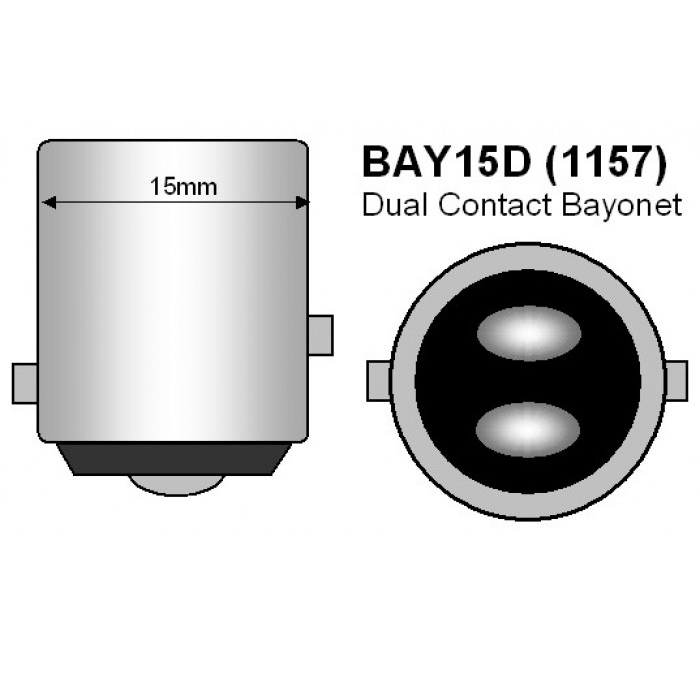
What is the difference between: BA15S/BA15D/BAU15S/BAU15D/BAY15S/BAY15D?
BA15S Single Filament
BA15D Dual Filament

BAU15S Single Filament/Off-Set Pins (Horizontal)
BAU15D Dual Filament/Off-Set Pins (Horizontal)
BAY15S Single Filament/Off-Set Pins (Vertical)

BAY15D Dual Filament/Off-Set Pins (Vertical)
What is the difference between warm white, cool white and pure white?
Warm white, cool white and pure white all give off a different hue or “shade” of white all of which are measured on a kelvin scale. Warm white is also known as a soft white and has a bit of yellow to it, similar to the color of a incandescent bulb. A cool white bulb will resemble the color of a fluorescent bulb which is a white/blue mix while a pure white bulb is in the middle of a warm and cool white. Pure white LED bulbs feature no visible color (yellow or blue) just a pure white light output.

Which color LED should I choose?
For best results, we recommend using the LED color that matches the lens or if there is a bulb behind a clear lens, use the appropriate color for turn and brake light functions. Generally brake/running lights will be red while turn signals and marker lights are amber. For example: A red lens will filter our all but the red portion of the light so if the light is all red, none or very little light will be blocked by the lens.
If I install LED bulbs in my dash lights/cluster, will my dimmer still work?
Yes, our LED bulbs will dim with your dash light controls.